
How Anime Fandom Taught a Generation to Talk to Strangers Online

If you have ever refreshed a fan theory thread at two in the morning, argued about subs versus dubs, or traded episode recommendations with someone whose real name you never learned, you already know the truth: anime fandom has always been a machine for talking to strangers. Long before algorithms decided what we watch and who we talk to, otaku culture ran on conversation with people we had never met, and it got strangely good at it.
The fansub era: conversation as currency
In the 1990s and early 2000s, if you wanted anime that had not reached your country, you did not open a streaming app. You went where strangers were trading files, encodes and opinions: IRC channels, mailing lists, forum threads. Fansub groups were communities of strangers cooperating across time zones, typesetting karaoke they would never be credited for.
Here is the detail people forget: the file was never the only point. The first question in any channel was rarely about the download. It was about the show. Is it worth watching, which arc is better, what should I pick up next. Recommendation culture, the lifeblood of modern fandom discourse, was born in conversations between people who knew nothing about each other except a shared queue of episode files.
Gaia Online, MAL and the golden age of the anime forum
For a while the fandom had towns. Gaia Online let anime fans hang out in themed spaces with avatars, shops and endless roleplay threads. MyAnimeList turned profiles into icebreakers: comment sections, clubs, recommendation threads where a stranger’s taste in mecha decided whether you trusted their winter lineup. Anonymous boards ran on loud, unfiltered opinion with no profiles at all.
Crossing paths with strangers was not a malfunction of those platforms. It was the main feature. You did not choose your conversation partners from a friend list. You met them in the comment section of a review, argued with them for three pages, and sometimes that stranger ended up being the person you gamed with for the next decade.
Discord centralizes the fandom, and quietly ends the era of strangers
Then Discord arrived and became the default. Big public servers now have hundreds of thousands of members, organized into neat topical channels. For coordination, events and containing fandom drama, it works beautifully.
But notice what happened: in a fandom server, you mostly end up talking to people who already share your exact niche and arrived through the same invite link. The unknown stranger, the person from a completely different corner of the internet who just happens to love the same show, became rare. Fandom conversation got safer and better organized, and a little less adventurous.
The return of random chat
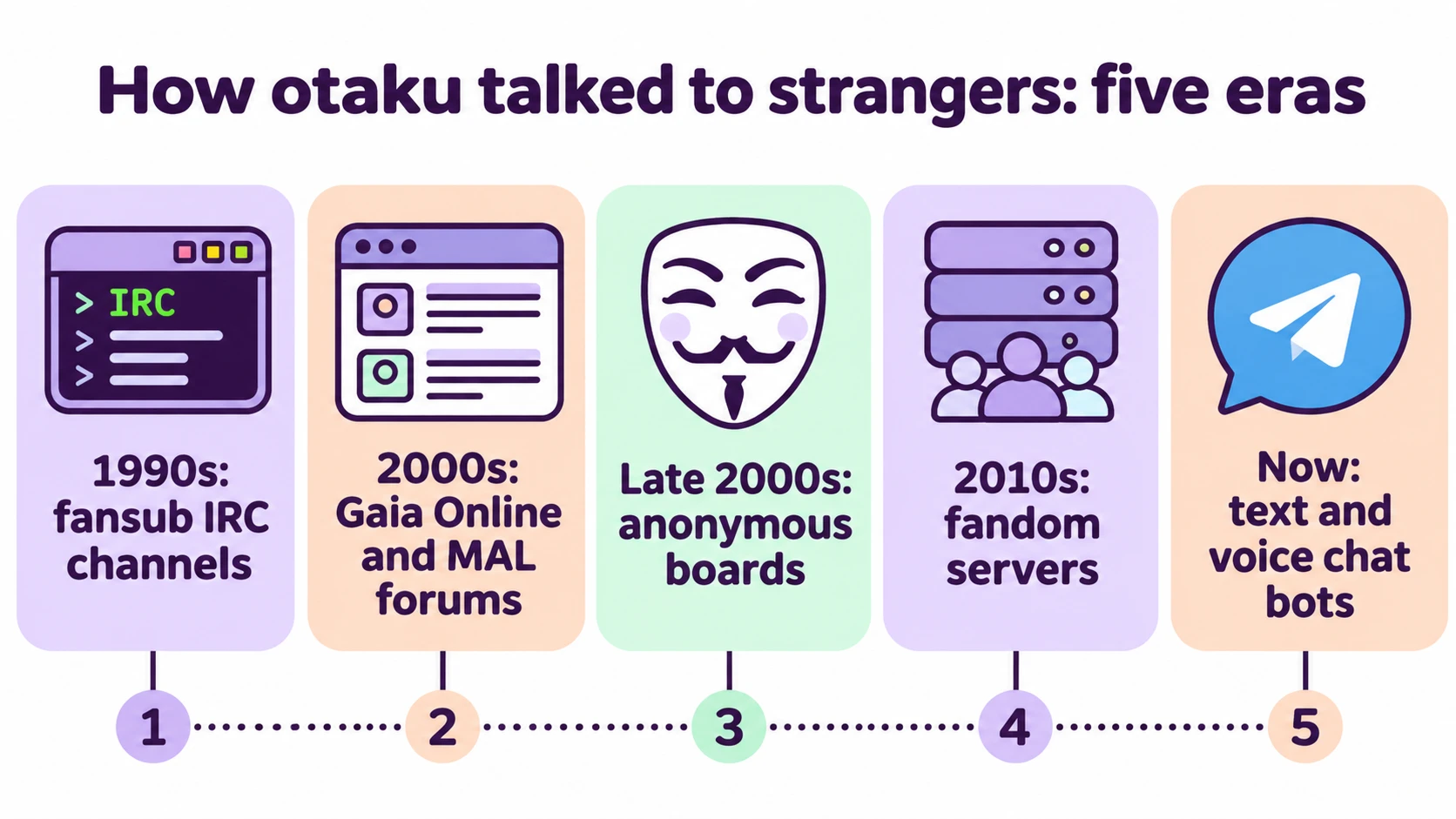
Outside fandom, the appetite for strangers never went anywhere. Random chat as a format was born in 2009 with Omegle, went viral through the video era of Chatroulette and OmeTV, and survived Omegle’s shutdown in November 2023. What is interesting is the branch that came after: services that dropped the camera entirely and went text and voice first.
Chatus is a good example of where the format landed. It runs the roulette inside Telegram: you open it, tap search, and a stranger appears in seconds. No registration, no profile, and notably no camera: conversations run on text and voice messages only. The data from your Telegram profile is not shown to the other person, so whatever they learn about you is what you choose to type. According to Chatus, an average match takes 0.56 seconds, the platform counts more than a million monthly active users, and around 500,000 new conversations start every day.
The base experience is free. An optional Premium tier at $1 a day, paid with Telegram Stars, adds search filters like the gender and age of your match, plus a flirt room and an ad-free experience. Two things are worth saying clearly: those are search filters, not guarantees of who appears on the other side. And the service is strictly for users 18 and over.
If you want the long version, Chatus has a dedicated chat with strangers page, and its anonymous chat section goes deeper on talking without a public profile.
Five forum rules that still work in random chat
Fandom etiquette from the IRC days maps onto modern random chat almost one to one:
- Open with something specific. “Which anime got you into the hobby” beats “hi”. Strangers reward curiosity.
- Share opinions, not personal data. Your real name, address, phone number and financial details stay out of the chat, and so do links from people you just met.
- Lurk less, contribute. A thread you never post in is a conversation that never happens. Same with a match you never message.
- Respect the no. If the other person is not interested in the topic, or in you, move on gracefully. Forum moderation once handled this slowly and painfully; today there is a report button, use it when someone crosses a line.
- Leaving is allowed. Threads died, chats close. The whole magic of the format is that you can start a new one in seconds.
The core skill never changed
Anime fandom did not invent talking to strangers online, but it kept the habit alive with more passion than almost any other community. Whether it was an IRC channel in 1999 or a Telegram bot this evening, the skill is the same one Gaia Online hammered into a generation: say something real to someone you do not know, and see what grows out of it.