
Python for Automation Course vs Self-Teaching: An Honest Comparison
You want to learn Python for automation. The question isn’t whether to learn — it’s how. Take a structured Python for automation course? Or teach yourself using free resources? Both paths can work. Both have succeeded for thousands of people. But they’re fundamentally different experiences with different tradeoffs.
This isn’t a sales pitch for either approach. It’s an honest comparison to help you choose the path that fits your situation, learning style, and goals. Canadian learners exploring structured options can find local programs in this guide to Python automation courses in Canada.

The Self-Teaching Path
Self-teaching means assembling your own curriculum from free (or cheap) resources: YouTube tutorials, documentation, blog posts, Stack Overflow, free courses on platforms like freeCodeCamp or Codecademy’s free tier.
The Genuine Advantages
Cost: Near zero. The obvious benefit. Python documentation is free. YouTube has thousands of tutorials. Stack Overflow answers almost any question. You can learn automation without spending money on courses.
Flexibility: Total. Learn at 2am if that’s when you have time. Skip topics you already know. Deep-dive into areas that fascinate you. No syllabus dictates your path.
Depth control: Yours. Want to spend three weeks mastering pandas? Nobody stops you. Want to skip web scraping entirely? Your choice. Self-teaching lets you customize depth per topic.
Research skills: Built-in. Finding answers independently is a skill. Self-teachers develop strong Google-fu, documentation reading, and problem-solving habits that serve them forever.
The Real Challenges
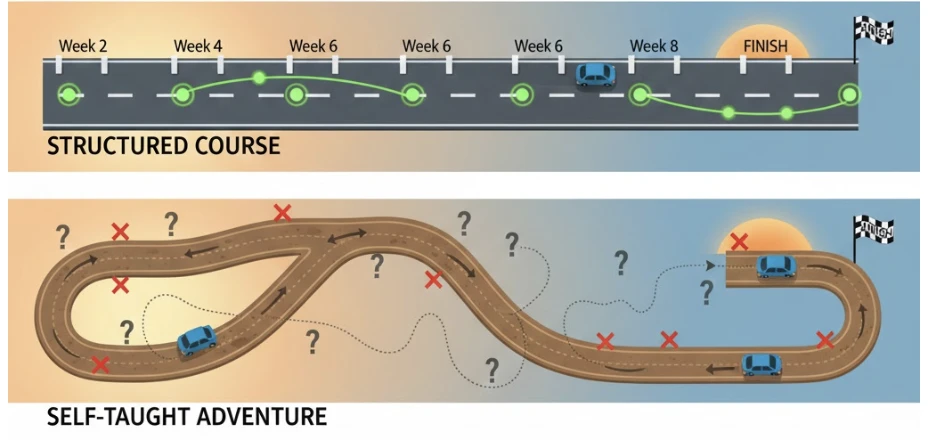
Curriculum assembly: On you. What should you learn? In what order? How deep? These questions have no obvious answers. You’ll likely learn things you don’t need while missing things you do. The path isn’t clear until you’ve already walked it.
Quality inconsistency: Constant. That YouTube tutorial might be excellent or terrible. That blog post might use outdated practices. Without expertise to judge, you can’t tell good resources from bad until after investing time in them.
Gaps you don’t know exist: Hidden. You don’t know what you don’t know. Self-teachers often build functional skills with fundamental gaps — things a structured course would have covered that you never encountered.
Motivation: Entirely internal. No deadlines. No accountability. No one notices if you skip a week. When motivation dips — and it will — nothing external pushes you forward. Discipline must come from within, consistently, for months.
Support when stuck: Limited. Stack Overflow helps with specific errors. But “I don’t understand why this approach isn’t working for my situation” is harder to resolve. No instructor explains concepts differently when the first explanation doesn’t click.
Time to competence: Typically longer. The meandering path — wrong turns, dead ends, missing pieces — usually extends the timeline. Self-teachers often report 6-12 months to reach competence that structured courses achieve in 2-3 months.

The Structured Course Path
A Python for automation course provides curated curriculum, sequenced learning, projects, and usually some form of support — whether instructor access, community, or both.
The Genuine Advantages
Curriculum: Solved. Someone who knows the destination designed the path. Topics are sequenced logically. Foundational concepts come before advanced ones. Nothing critical is accidentally skipped.
Quality assurance: Built-in. Course materials are (usually) vetted. Examples work. Explanations have been refined through student feedback. You’re not gambling on whether this resource is good.
Time efficiency: Significant. No time lost finding resources, evaluating quality, or discovering you learned the wrong thing. The direct path is faster. Most structured courses achieve competence in 8-12 weeks of part-time study.
Accountability: External. Deadlines, cohort peers, progress tracking, instructor check-ins — courses provide external structures that keep you moving when internal motivation wavers.
Support when stuck: Available. Questions get answered. Concepts get re-explained. Someone reviews your code and points out issues. You’re not alone in the struggle.
Completeness: Designed. Courses aim to produce capable graduates. The designer thought about what “done” looks like and built toward it. You finish with a coherent skill set, not random fragments.
The Real Challenges
Cost: Real money. Quality courses cost hundreds to thousands of dollars. That’s a barrier for many people and a risk — what if the course isn’t good? What if you don’t finish?
Pace: Not yours. Too fast and you’re lost. Too slow and you’re bored. Courses optimize for the average learner, which means they’re suboptimal for anyone not average.
Curriculum: Fixed. The course covers what it covers. If your specific automation need isn’t included, you’re back to self-teaching for that piece anyway.
Dependency risk: Created. Learning within a structure can create reliance on structure. Some course graduates struggle to learn new things independently because they’ve never had to find their own resources.
Quality variance: Still exists. Not all courses are good. Plenty of expensive courses have poor instruction, outdated content, or theoretical focus that doesn’t serve automation goals. Cost doesn’t guarantee quality.
The Honest Timeline Comparison
How long to reach “can automate real work tasks independently”?
Structured course (quality): 8-12 weeks at 6-10 hours weekly. Total: 60-120 hours. Direct path, minimal wasted time, designed for this outcome.
Self-teaching (dedicated): 4-8 months at similar hours. Total: 150-300+ hours. Includes time finding resources, backtracking from poor ones, filling gaps discovered late, and wandering without direction.
Self-teaching (casual): 8-18 months. Often never reaches true competence — perpetual “still learning” without completing the journey.
The time difference isn’t just about efficiency. Longer timelines mean more opportunities for life to interrupt. More chances to lose momentum. Higher likelihood of abandoning the goal entirely.
Who Should Self-Teach
Self-teaching makes sense when:
You have exceptional self-discipline. Not “pretty good” — exceptional. You can maintain consistent effort for months without external accountability. You’ve done this before with other skills.
You genuinely can’t afford any course. If the choice is self-teach or don’t learn at all, self-teach. Imperfect progress beats no progress.
You already have programming fundamentals. If you know another language, self-teaching Python is much easier. You’re learning syntax, not concepts. The transfer accelerates everything.
You enjoy the research process. Some people genuinely like hunting for resources, comparing approaches, and discovering things independently. If that’s you, self-teaching is rewarding, not frustrating.
Your automation needs are narrow. If you only need to automate one specific task, targeted learning might be faster than a comprehensive course. Learn exactly what you need, nothing more.
Who Should Take a Course
A structured Python for automation course makes sense when:
Your time is more valuable than course cost. If a course saves 100 hours and costs $500, that’s $5/hour for your time. Many professionals’ time is worth far more. The math favors courses.
You’ve tried self-teaching and stalled. This is common. Started tutorials, got confused, stopped. A course might provide the structure that makes the difference.
Accountability helps you. If external deadlines and expectations help you follow through, courses provide what self-teaching can’t.
You’re starting from zero. Complete beginners benefit most from structured curriculum. You don’t yet know what you don’t know — let the course designer worry about that.
You want comprehensive skills, not just specific solutions. Courses build systematic capability. You finish able to approach new automation challenges, not just repeat what you learned.
Speed matters. Career opportunity, urgent work need, or limited learning window? The faster path has value beyond just time saved.
The Hybrid Approach
Many successful learners combine both:
Course for foundations. Get the structured start, build core skills, develop working capability. Let the curriculum solve the “what to learn” problem.
Self-teaching for specialization. After the course, deepen specific areas relevant to your work. Learn that niche library. Master that particular automation type. Now you have the foundation to evaluate resources and learn independently.
This hybrid captures benefits of both. Structure when you need it most (the beginning). Independence when you’re equipped for it (after foundations).
Questions to Ask Yourself
Before deciding, honestly answer:
Have I successfully self-taught technical skills before? Past behavior predicts future behavior. If you’ve done it, you can probably do it again. If you haven’t, don’t assume this time will be different.
What happens when I get stuck and frustrated? Do you push through independently? Or do you need help to get unstuck? Your answer determines how much support you need.
How long can I sustain motivation without visible progress? Self-teaching has longer plateaus. Can you persist through weeks of unclear advancement?
What’s the real cost of taking longer? If slower learning delays automation benefits by six months, what’s that worth? Sometimes the “free” path is actually more expensive.
Am I being honest about my discipline? Most people overestimate their self-discipline. If you have a history of unfinished online courses, started-but-abandoned projects, or good intentions that fade — be honest about that pattern.
Making the Choice
Neither path is universally better. The right choice depends on your specific situation:
Choose self-teaching if: you have proven self-discipline, existing programming knowledge, limited budget, and you enjoy independent learning.
Choose a structured course if: you’re starting from zero, value time over money, benefit from accountability, and want comprehensive skills quickly.
Choose hybrid if: you want fast foundations but also plan to specialize in areas beyond any single course’s scope.
The worst choice is no choice — endlessly researching options without starting either path. Analysis paralysis wastes more time than either approach ever could.
If a structured course fits your situation, the LearnForge Python Automation Course offers the direct path: curated curriculum, practical projects, real automation skills, and support when you need it. If self-teaching fits better, start today — the resources are out there waiting.
Either way, start. The Python automation skills you want are achievable. The only question is which path gets you there.